

ChatGPT is an AI chatbot built by OpenAI that can understand text you type and generate human-like responses back. It is based on a large language model, which is a type of AI trained on huge amounts of text. In this guide, you will learn what ChatGPT is, how it generates responses, what it can and can't do, and real examples of how people use it.
What is ChatGPT and How Does It Work?
ChatGPT is an AI system that takes your typed message, called a prompt, and generates a text response based on patterns it learned during training. It does not search the internet for every answer — it mostly relies on knowledge built into it during training, along with anything you've shared earlier in the same conversation.
At a basic level, ChatGPT works in three steps:
- You type a question or instruction.
- The AI processes your text and predicts the most likely, helpful response.
- It generates that response one piece at a time, and shows it to you.
Example: A Simple ChatGPT Conversation
This example shows the basic back-and-forth pattern of using ChatGPT, where a plain question leads to a direct, generated answer. It sets up the core idea of what "using ChatGPT" actually looks like in practice.
def chatgpt_reply(prompt):
    if "capital of France" in prompt:
        return "The capital of France is Paris."
    return "I can help with that, tell me more."

print(chatgpt_reply("What is the capital of France?"))
Explanation:
This code is a simplified stand-in for how ChatGPT works — it takes your typed prompt as input and returns a generated text response. A real ChatGPT model does this using a much larger, trained language model instead of simple rules like this example.
How ChatGPT Generates Responses (LLM Basics)
ChatGPT is built on a large language model, or LLM (Bold), which is trained on massive amounts of text from books, websites, and articles. During training, the model learns patterns in language — which words and phrases usually follow other words and phrases.
When you send a message, the LLM does not "look up" an answer like a search engine. Instead, it predicts the next most likely word, one at a time, based on everything written so far, and keeps repeating this until the full response is complete.
Example: Predicting the Next Word
This example shows a tiny, simplified version of next-word prediction, the core process behind how an LLM builds a sentence. It demonstrates the basic idea in a way that's easy to follow, without needing real model training.
next_word_options = {
    "The sky is": "blue",
    "I like to eat": "pizza"
}

sentence = "The sky is"
print(sentence, next_word_options[sentence])
Explanation:
This code picks the most likely next word based on the given phrase, similar to how an LLM predicts one word after another. Real models like ChatGPT do this using billions of learned patterns, not a simple fixed list like this example.
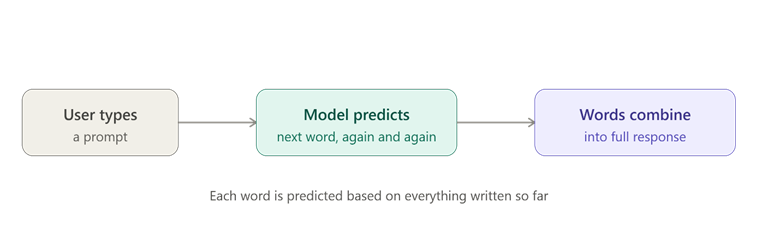
This picture shows how ChatGPT builds a response by predicting one word after another, based on your prompt.
What ChatGPT Can and Can't Do
ChatGPT is a powerful tool, but it has real limits that are important to understand before relying on it fully.
What ChatGPT can do:
- Answer general knowledge questions in plain language
- Write, explain, and debug code in many programming languages
- Summarize long text into shorter, simpler versions
- Draft emails, essays, and other written content
- Translate text between many languages
What ChatGPT can't do (reliably):
- Know about events after its training data ends, unless it has live web access
- Guarantee every fact is correct — it can confidently state wrong information, known as hallucination
- Truly "understand" meaning the way a human does — it predicts patterns, not conscious thought
- Access private, personal data about you unless you share it in the conversation
- Take real-world physical actions on its own, without a connected tool
Comparison Table: ChatGPT Strengths vs Limitations
| Area | ChatGPT Can Do | ChatGPT Struggles With |
| Knowledge | Explain known facts and concepts clearly | Guaranteeing every detail is fully accurate |
| Writing | Draft essays, emails, code | Knowing your exact personal intent without context |
| Timeliness | Answer general, stable topics | Very recent events without added tools |
| Reasoning | Follow logical steps in a written explanation | True understanding, versus predicting patterns |
Real-World Examples of ChatGPT in Use
ChatGPT is used across many everyday and professional tasks, not just casual conversation.
- Students: Use ChatGPT to get simple explanations of difficult topics, or to check their understanding of a concept.
- Developers: Use ChatGPT to write starter code, debug errors, or explain what a piece of code does.
- Writers: Use ChatGPT to brainstorm ideas, fix grammar, or rewrite a paragraph in a different tone.
- Businesses: Use ChatGPT to draft customer support replies or summarize long reports quickly.
- Language learners: Use ChatGPT to practice conversations or get instant translations.
Example: Using ChatGPT to Summarize Text
This example shows a common real use case — turning a long paragraph into a short summary. It reflects one of the most practical, everyday ways people actually use ChatGPT.
long_text = "Python is a popular programming language known for its simple syntax. It is used in web development, data science, and automation. Many beginners choose Python as their first language."

def summarize(text):
    return "Python is a beginner-friendly language used in web development, data science, and automation."

print(summarize(long_text))
Explanation:
This code represents what ChatGPT does when asked to summarize text — it takes a longer passage and returns a much shorter version that keeps the key points. A real ChatGPT model does this by understanding the meaning of the full text, not by using a fixed rule like this simplified example.
Conclusion
ChatGPT is an AI chatbot built on a large language model that generates responses by predicting text one word at a time, based on patterns learned during training. It is genuinely useful for tasks like writing, coding, and summarizing, but it has real limits, including outdated knowledge and occasional confident mistakes. The key takeaway is that ChatGPT works best as a helpful assistant you double-check, not a source of guaranteed, always-correct facts.