
Showing ChatGPT a few examples before asking your real question often gets more consistent, accurate results than just asking directly.
What Is Few-Shot Prompting?
This part explains the core idea before showing it in action.
Few-shot prompting means including a few examples of the input-output pattern you want, before asking ChatGPT to continue that same pattern on new input. This is different from zero-shot prompting, where you ask directly with no examples at all.
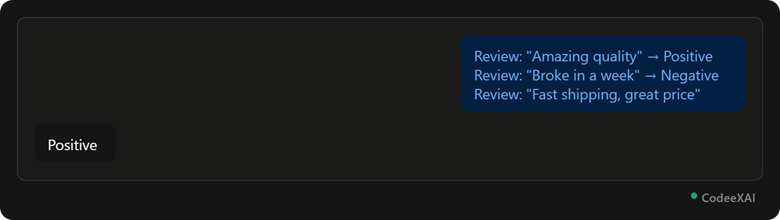
This picture shows two labeled examples teaching the pattern, then ChatGPT correctly labeling a new, unlabeled review by following that same pattern.
Why it works: The two examples show exactly what "Positive" and "Negative" mean in this context, so ChatGPT applies the same labeling logic to the new review instead of guessing.
Example-Based Prompt Templates
This part gives you a reusable structure for writing your own few-shot prompts.
A few-shot prompt generally follows this template:
[Input example 1] → [Output example 1]
[Input example 2] → [Output example 2]
[New input] →
Example template in use:
Translate to formal English:
"gonna" → "going to"
"kinda" → "kind of"
"wanna" →
Explanation:
Each line shows the exact transformation ChatGPT should apply — informal word to formal word. When it reaches "wanna" with no answer given, it follows the same pattern and completes it with "want to."
When to Use Few-Shot vs Zero-Shot
This part helps you decide which approach fits your task.
Zero-shot works well for general knowledge questions or simple tasks ChatGPT already understands clearly. Few-shot works better when you need a very specific format, style, or judgment call that's easier to show than describe.
Comparison Table: Few-Shot vs Zero-Shot
This table compares when each approach is the better choice.
| Situation | Best Approach | Why |
| "What is the capital of Japan?" | Zero-shot | Simple factual question, no ambiguity |
| Custom categorization or scoring | Few-shot | Examples define your exact criteria |
| Matching a specific writing style | Few-shot | Easier to show than describe in words |
| General explanations or summaries | Zero-shot | ChatGPT already handles this well |
Conclusion
Few-shot prompting teaches ChatGPT a pattern through examples before asking it to continue that pattern, which works best for specific formats or judgment calls. Zero-shot prompting skips examples entirely and works fine for straightforward questions. Choosing between them comes down to how much precision your task actually needs.