GPT Model Comparison Overview
This part introduces all three models before comparing them point by point.
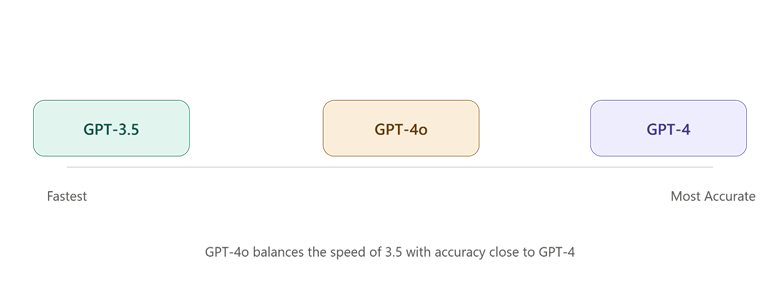
GPT-3.5 has around 175 billion parameters, while GPT-4 is significantly larger and more complex, with an estimated 1 trillion parameters and a more advanced transformer architecture. GPT-4o (Bold), released in mid-2024, is a multimodal model that integrates text, vision, and audio in one model, and matches GPT-4 in English text and coding while performing better on non-English languages and vision tasks.
Note: as of 2026, GPT-5 is OpenAI's current flagship model, so GPT-3.5 and GPT-4 are now considered legacy models, mostly kept for comparison or specific older workflows rather than everyday use.
Comparison Table: GPT-3.5 vs GPT-4 vs GPT-4o
This table lines up the three models across the factors that matter most when picking one.
| Feature | GPT-3.5 | GPT-4 | GPT-4o |
| Parameters (approx.) | ~175 billion | ~1 trillion | Optimized, undisclosed |
| Multimodal (image/audio) | No | Image input only | Text, image, and audio in one model dev |
| Accuracy | Lower | Higher | Matches GPT-4 on text/code |
| Speed | Fastest | Slower | Faster and less expensive to run than GPT-4 Turbo dev |
| Released | 2022 | 2023 | 2024 |
Speed vs Accuracy Tradeoffs
This part explains the practical tradeoff you feel when actually using each model.
GPT-3.5 responds the fastest but makes more factual mistakes. GPT-4 is 82 percent less likely to respond to disallowed content and 40 percent more likely to produce factual responses than GPT-3.5, but it runs slower and costs more to operate. GPT-4o improves interaction speed but may compromise some precision, with users reporting more frequent hallucinations compared to GPT-4 — a direct tradeoff between speed and accuracy. microsoft
Example:
A quick, casual chat question runs fine on GPT-3.5. A legal or technical question needing precise facts is safer on GPT-4, where accuracy matters more than response speed.
Which Model Is Available on Which Plan?
This part connects the model differences to the ChatGPT plans that unlock them.
- Free plan: Limited access to the current flagship model, with a lighter fallback model after hitting daily caps. GPT-3.5 was historically the default free model before newer models replaced it.
- Plus plan: Full access to GPT-4o and higher-tier reasoning models, with much higher usage caps.
- Team/Enterprise: Same or higher model access as Plus, plus admin controls and compliance features — the model tier itself doesn't change, just the usage limits and governance around it.
When to Use Which Model
This part gives direct, practical guidance for picking a model based on your task.
- Use GPT-3.5 (or the lightweight fallback model) for: Quick, low-stakes questions, casual chat, or simple text generation where speed matters more than precision.
- Use GPT-4 for: Complex reasoning, technical writing, or tasks needing higher factual accuracy.
- Use GPT-4o for: Tasks involving images, voice, or a mix of text and media, or when you want GPT-4-level accuracy at faster response times.
Conclusion
GPT-3.5 favors speed, GPT-4 favors accuracy, and GPT-4o balances both while adding multimodal support for text, image, and audio. Your plan determines which models you can access, and your task determines which one you should pick. As of 2026, GPT-5 has succeeded these models as OpenAI's flagship, but the same speed-vs-accuracy tradeoff principle still applies when choosing between model tiers.