

The clearer your prompt, the better ChatGPT's answer. Here's what vague prompts actually produce, versus specific ones — side by side.
Vague Prompt Examples and Their Weak Outputs
This part shows what happens when a prompt leaves too much unsaid.
A vague prompt gives ChatGPT little to work with, so it has to guess what you actually want, often producing a generic, unfocused answer.
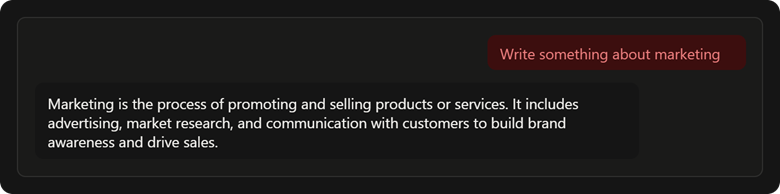
This picture shows a vague prompt producing a generic textbook definition — technically correct, but not useful for any real task.
Why it's weak: "Write something about marketing" doesn't say what format, audience, or purpose is needed, so ChatGPT defaults to a broad, textbook-style answer.
Specific Prompt Examples and Improved Outputs
This part shows how adding detail changes the exact same topic into a usable answer.
A specific prompt tells ChatGPT the exact task, audience, and format, so the response is directly usable instead of generic.
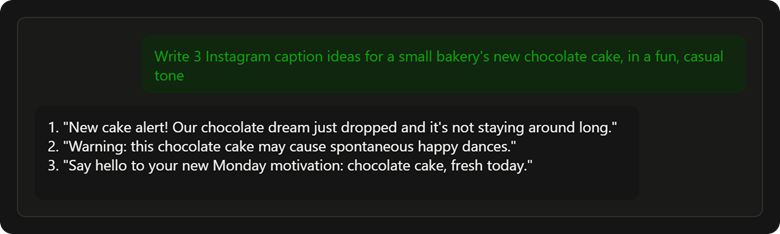
This picture shows a specific prompt producing three ready-to-use captions, matching the exact platform, product, count, and tone requested.
Why it's strong: This prompt names the platform (Instagram), the exact task (caption ideas), the quantity (3), the subject (chocolate cake), and the tone (fun, casual) — leaving no guesswork for ChatGPT.
Before/After Comparison Exercises
This part gives you a few pairs to practice rewriting vague prompts into specific ones yourself.
Comparison Table: Vague vs Specific Prompts
This table lines up weak prompts against stronger rewrites, so you can see the exact pattern to copy in your own prompts.
| Vague Prompt | Specific Prompt |
| "Give me advice" | "Give me 3 tips for staying motivated while studying for exams" |
| "Write a poem" | "Write a 4-line poem about rain, in a calm, peaceful tone" |
| "Explain AI" | "Explain what AI is to a 12-year-old, using one simple everyday example" |
| "Help with my resume" | "Rewrite this resume bullet point to sound more results-focused: [paste text]" |
Exercise: Try rewriting "Give me a recipe" into a specific version — include the dish, dietary need, and cooking time — then compare the two outputs yourself.
Conclusion
Vague prompts get generic, one-size-fits-all answers, while specific prompts — naming the format, audience, tone, and quantity — get answers you can actually use right away. The fastest way to improve any prompt is to add the details a vague version leaves out.