

A well-structured prompt gets a better response. Here's how instruction, context, and input format work together, and when to keep prompts short or make them longer.
Instruction + Context + Input Format
This part breaks down the three building blocks that make up a strong prompt.
A good prompt usually has three parts: the instruction (what you want done), the context (background info ChatGPT needs), and the input format (how you want the answer structured).

Example: "Write a summary of this email thread in 3 bullet points" combines all three parts into one clear prompt.
Ordering Elements in a Prompt
This part explains whether the order of instruction, context, and format actually matters.
Putting the instruction first usually works best, since ChatGPT immediately knows what task it's doing before reading the details. Context and format can follow in any order after that.
Comparison Table: Prompt Ordering
This table compares two ways of ordering the same prompt, showing why leading with the instruction is the clearer choice.
| Order | Example | Clarity |
| Instruction first | "Summarize this in 3 points: [text]" | Clear, task known upfront |
| Context first | "[text] — summarize this in 3 points" | Works, but task comes late |
Short vs Long Prompts
This part explains when a quick one-line prompt works and when you need more detail.
Short prompts work for simple, general questions. Long prompts work better for specific, detailed tasks where extra context changes the result.
- Use a short prompt: "What is Python?"
- Use a long prompt: "Explain what Python is to a 10-year-old, using a simple analogy, in under 50 words."
Structuring Multi-Part Requests
This part shows how to ask for several things at once without confusing ChatGPT.
For multi-part requests, list each part clearly, usually as numbered points, instead of cramming everything into one sentence.
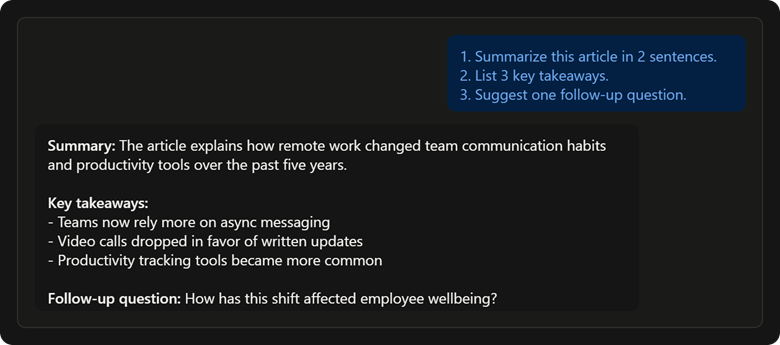
This picture shows the numbered multi-part prompt on the right, and ChatGPT's matching numbered response on the left — each part answered separately in order.
What happened: ChatGPT matched each numbered request in the prompt with a clearly labeled section in the response — summary, key takeaways, and a follow-up question — instead of blending everything into one paragraph. This is exactly why numbering each part keeps a multi-part response organized.
Conclusion
A strong prompt combines instruction, context, and format, with the instruction placed first for clarity. Keep prompts short for simple questions and longer for detailed tasks, and number each part when asking for multiple things at once — the numbered example above shows how ChatGPT mirrors that structure back in its response.