

An intelligent agent in ai is a program that can look around, think a little, and then do something on its own. It is one of the most basic ideas in Artificial Intelligence. In this guide, you will learn what it is, how it works, and where you see it every day.
What is an Intelligent Agent?
This part tells you the simple meaning of an intelligent agent, in easy words.
An intelligent agent is anything that can do three things:
- Sense its surroundings (look, listen, or read data)
- Think about what it senses
- Act to finish a task or reach a goal
It can be a software program, a robot, or even a small piece of code. The main job of an intelligent agent in AI is to make good choices on its own, without a person telling it every single step.
Example: A self-driving car is an intelligent agent. It senses the road with cameras, thinks about what to do, and then acts by turning the wheel or pressing the brake.
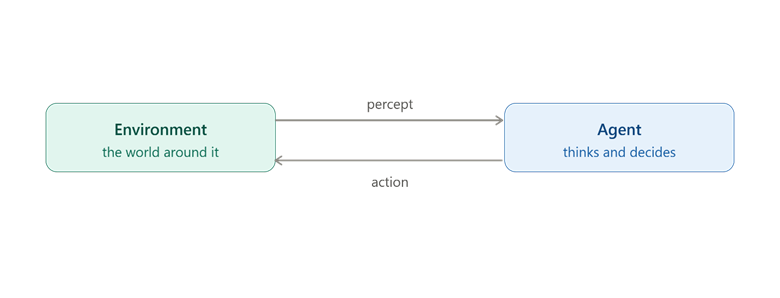
This picture shows the two-way loop between the agent and its world — the agent gets a percept in, and sends an action out.
What are Percepts and Actions?
This part explains two simple words you must know — percept and action.
Every intelligent agent works using two steps: percept and action.
- Percept: This is what the agent sees, hears, or gets from the world at any moment. It is the input.
- Action: This is what the agent does after thinking about the percept. It is the output.
This happens again and again, in a loop. The agent keeps sensing, thinking, and acting.
Example: A spam filter in your email is an agent.
- Percept: It reads the words in a new email.
- Action: It moves the email to the Spam folder if it looks suspicious.
The full list of everything an agent has sensed so far is called the percept sequence. The agent uses this history to make smarter choices.
Real Examples of an Intelligent Agent in AI
This part shows easy, everyday examples so you can connect the idea to real life.
You already use an intelligent agent every day without knowing it:
- Voice assistants like Siri or Alexa — they sense your voice and act by answering or playing music.
- Smart thermostats — they sense room temperature and act by turning heating on or off.
- Chatbots on websites — they sense your typed question and act by giving an answer.
- Robot vacuum cleaners — they sense walls and furniture and act by changing direction.
V
visualize
V
visualize show_widget
This picture shows four common tools you use every day that are all intelligent agents.
Types of Environment for an Intelligent Agent
This part explains the different kinds of "worlds" an agent can work in, using simple words.
The environment is the place or situation where the agent works. Not all worlds are the same. Here are the main types:
- Observable Environment: If the agent can see the full picture, it is fully observable. If it can see only part of it, it is partially observable.
- Example: Chess is fully observable — both players see the whole board.
- Deterministic Environment: The next situation can be fully guessed from the current one and the agent's action. Nothing random happens.
- Example: A calculator app — the same input always gives the same answer.
- Stochastic Environment: The result is not always the same, even with the same action. There is some chance involved.
- Example: Weather can change without warning.
- Episodic Environment: Each task is separate. The agent's next action does not depend on its past actions.
- Example: An agent that checks photos and marks each one as "cat" or "not cat" — each photo is a new task.
- Sequential Environment: Past actions affect future choices. The agent must plan ahead.
- Example: Chess — every move affects the next moves.
- Static Environment: The world does not change while the agent is thinking.
- Example: A crossword puzzle stays the same while you solve it.
- Dynamic Environment: The world can change while the agent is still thinking or acting.
- Example: Self-driving cars — other cars keep moving.
- Discrete Environment: There is a fixed, small number of clear states and moves.
- Example: Tic-tac-toe has a limited number of moves.
- Continuous Environment: There are endless possible states, changing smoothly.
- Example: Driving a car — speed and steering change smoothly.
Comparison Table: Types of Agent Environments
| Environment Type | Meaning in Simple Words | Example |
|---|---|---|
| Fully Observable | Agent sees everything | Chess |
| Partially Observable | Agent sees only part | Self-driving car in fog |
| Deterministic | Same action gives same result | Calculator |
| Stochastic | Result can change | Weather |
| Episodic | Tasks are separate | Photo sorting |
| Sequential | Past moves matter | Chess moves |
| Static | World stays still while thinking | Crossword puzzle |
| Dynamic | World keeps changing | Traffic while driving |
| Discrete | Limited fixed choices | Tic-tac-toe |
| Continuous | Endless smooth changes | Car speed control |
Conclusion
An intelligent agent in ai is simply a system that senses its world, thinks, and takes action to reach a goal. It does this through a nonstop loop of percepts and actions. The type of environment it works in — like observable, deterministic, or dynamic — decides how hard or easy its job is. Once you understand this basic idea, most other AI ideas become much easier to follow.