
Planning in artificial intelligence is how an AI system decides the right order of actions to reach a goal. It breaks a big goal into smaller steps and picks the best path to finish the task. In this guide, you will learn what planning means in AI, how goals get broken down into smaller parts, and see a simple robot navigation example.
What is Planning in Artificial Intelligence?
This part explains the basic meaning of planning in AI, in easy words.
Planning in artificial intelligence means an AI system looks at its current situation, looks at the goal it wants to reach, and then decides a list of actions to get there. It does not just react — it thinks ahead before acting.
A planning system usually needs three things:
- Initial state — where the agent starts
- Goal state — where the agent wants to reach
- Actions — the steps the agent is allowed to take
Example: When you use a maps app to reach a new place, the app plans your route. It knows your starting point, your destination, and the roads it can use, then picks the best path.
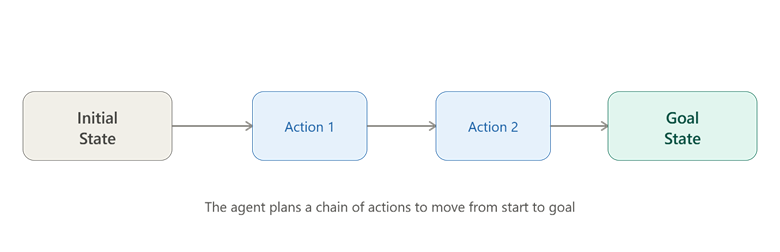
This picture shows how an AI planning system moves step by step from the initial state to the goal state.
Code Example:
initial_state = "Home"
goal_state = "Office"
actions = ["Walk to bus stop", "Take bus", "Walk to office"]

print("Start:", initial_state)
for step in actions:
    print("Action:", step)
print("Goal reached:", goal_state)
Explanation: This code just prints the starting point, then goes through each action one by one, and finally shows the goal. It is a simple way to show how a plan is just a list of steps between a start and a goal.
What is Goal Decomposition?
This part explains how a big goal gets broken into smaller, easier parts.
Goal decomposition means breaking one big goal into smaller subgoals, so the AI system can solve each small part step by step instead of solving everything at once. This makes hard problems much easier to plan.
Example: If the goal is "cook dinner," it can be broken into subgoals like:
- Buy ingredients
- Chop vegetables
- Cook the food
- Serve the food
Each subgoal is small and easy to plan on its own. Once all subgoals are done, the main goal is complete.
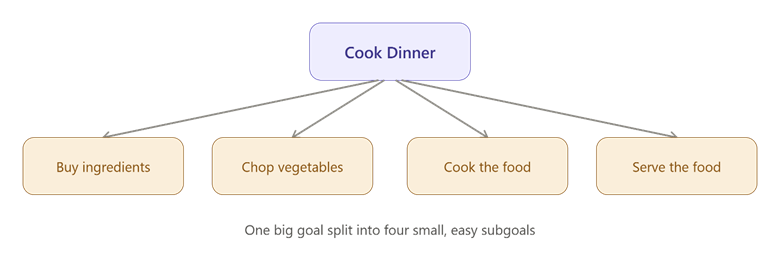
This picture shows how the main goal "cook dinner" splits into four smaller subgoals.
Code Example:
main_goal = "Cook Dinner"
subgoals = ["Buy ingredients", "Chop vegetables", "Cook the food", "Serve the food"]

print("Main goal:", main_goal)
for i, sub in enumerate(subgoals, 1):
    print(f"Subgoal {i}: {sub}")
Explanation: This code stores the small subgoals in a list, then prints each one with a number. This shows how a big goal turns into a numbered checklist of smaller subgoals.
Simple Planning Example: Robot Navigation
This part shows a real, simple example of planning in artificial intelligence using a robot that moves on a grid.
Imagine a robot placed on a small grid. It needs to move from its start box to a goal box, but it can only move up, down, left, or right, and it must avoid walls. Planning in artificial intelligence helps the robot pick the correct sequence of moves.
Example: If the robot starts at the top-left corner and the goal is the bottom-right corner, a simple plan could be:
- Move right
- Move right
- Move down
- Move down
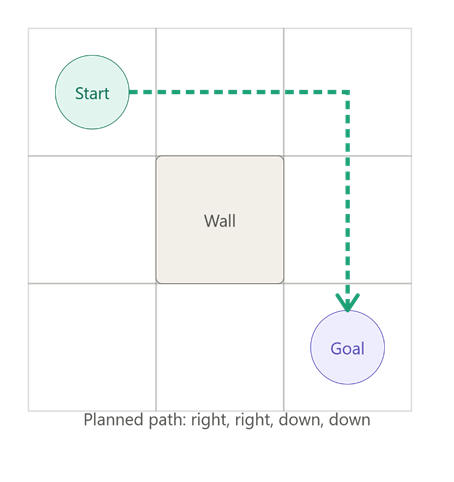
This picture shows the robot's planned path on a grid, moving around the wall to reach the goal.
Code Example:
position = [0, 0]     # robot start position (row, col)
goal = [2, 2]          # goal position
plan = ["right", "right", "down", "down"]

for move in plan:
    if move == "right":
        position[1] += 1
    elif move == "down":
        position[0] += 1
    print("Robot moved", move, "-> now at", position)

print("Reached goal!" if position == goal else "Not at goal")
Explanation: This code starts the robot at position [0, 0], then follows each move in the plan list, updating the robot's row and column. At the end, it checks if the robot's position matches the goal — this is exactly how simple planning in artificial intelligence works for robot navigation.
Comparison Table: Planning Terms in AI
| Term | Meaning in Simple Words | Example |
|---|---|---|
| Initial State | Where the agent starts | Robot at top-left of grid |
| Goal State | Where the agent wants to reach | Robot at bottom-right of grid |
| Action | A single step the agent can take | Move right, move down |
| Goal Decomposition | Splitting one goal into smaller subgoals | Cook dinner → buy, chop, cook, serve |
| Plan | The full list of actions to reach the goal | Right, right, down, down |
Conclusion
Planning in artificial intelligence is about deciding the right steps to move from a starting point to a goal, using goal decomposition to break big tasks into smaller, easier subgoals. The robot navigation example shows how even a simple grid problem uses the same planning idea used in real-world AI systems like maps apps and delivery robots. The key takeaway is that good planning turns one hard problem into a clear, ordered list of small, doable steps.