

A multi agent system is a setup where many AI agents work in the same world at the same time. Each agent can sense, think, and act on its own. Some agents help each other, and some agents compete with each other. In this guide, you will learn how a multi agent system works, with easy examples and simple code.
What is a Multi Agent System?
This part explains the basic meaning of a multi agent system in easy words.
A multi agent system (also called MAS) is a group of two or more AI agents that share the same environment. Each agent has its own goal and its own way of thinking. But they all affect each other, because they live in the same world.
This is different from a single agent, which works alone. In a multi agent system, agents must also think about what other agents are doing.
Example: A group of delivery robots in a warehouse is a multi-agent system. Each robot picks its own path, but they must avoid crashing into each other.
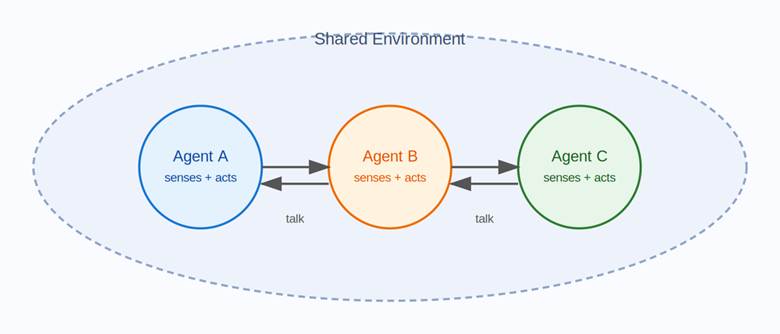
Multiple agents share one environment and talk to each other in a multi agent system.
Cooperative Agents in a Multi Agent System
This part explains agents that work together toward the same goal.
Cooperative agents share the same goal and help each other to finish a task faster or better. They share information and split the work between them.
This works well when a task is too big or too hard for one agent alone.
Example: A team of cleaning robots is cooperative. One robot cleans the kitchen while another cleans the hallway, so the whole house gets cleaned faster.
tasks = ["Kitchen", "Hallway", "Bedroom"]

def assign_tasks(agents, tasks):
    result = {}
    for i, task in enumerate(tasks):
        agent = agents[i % len(agents)]
        result.setdefault(agent, []).append(task)
    return result

agents = ["Robot A", "Robot B"]
print(assign_tasks(agents, tasks))
This code splits the task list between two robots, so no room is cleaned twice and the work gets done faster together.
Competitive Agents in a Multi Agent System
This part explains agents that work against each other to win.
Competitive agents have different goals, and one agent's win can be another agent's loss. Each agent tries to do better than the others, not help them.
This works like a game, where agents fight for the same limited prize, like money, points, or resources.
Example: Two trading bots in the stock market are competitive. Both want to buy the same low-priced stock first, so only one of them can win the deal.
bids = {"Bot A": 105, "Bot B": 110, "Bot C": 108}

def find_winner(bids):
    winner = max(bids, key=bids.get)
    return f"{winner} wins with bid {bids[winner]}"

print(find_winner(bids))
Each trading bot places a bid. The code checks all bids and picks the highest one, showing which competitive agent wins.
Comparison Table: Cooperative vs Competitive Agents
This part gives a quick side-by-side view to help you compare both types fast.
| Point | Cooperative Agents | Competitive Agents |
| Goal | Same shared goal | Different, conflicting goals |
| Behavior | Help each other | Try to beat each other |
| Information Sharing | Share freely | Share very little |
| Example | Cleaning robots | Trading bots |
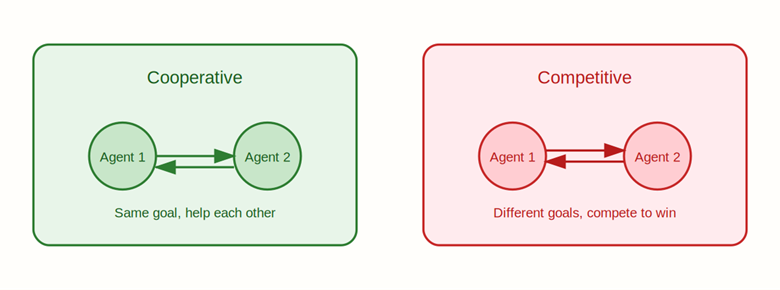
Cooperative agents work as a team, while competitive agents try to win against each other.
Communication Between Agents
This part explains how agents in a multi agent system talk to each other.
Agents in a multi agent system need communication to work well together, or to know what other agents are doing. They send small pieces of information called messages.
Common types of messages include:
- Inform: Sharing information, like "I finished my task."
- Request: Asking another agent to do something.
- Propose: Suggesting a deal, like in an auction.
Example: In a rescue mission, one drone can send a message like "Found survivor at zone 3" so other drones can help.
messages = []

def send_message(sender, content):
    messages.append({"from": sender, "content": content})

send_message("Drone 1", "Found survivor at zone 3")
send_message("Drone 2", "Moving to zone 3 to help")

for msg in messages:
    print(f"{msg['from']}: {msg['content']}")
This code stores each message with the sender's name. Every agent can read these messages to know what other agents have found or are doing.
Real-World Examples of a Multi Agent System
This part shows real examples so you can connect the idea to real life.
- Drone swarms: Many drones fly together to search an area, spray crops, or put on a light show. They talk to each other to avoid crashing and to cover more ground.
- Trading bots: Many bots buy and sell stocks or crypto at the same time. They compete to get the best price first.
- Traffic light systems: Smart traffic lights across a city act as agents that share data to reduce traffic jams.
- Multiplayer game bots: Non-player characters (NPCs) in games often work as a multi agent system, some teaming up and some fighting the player.
A multi agent system is simply many AI agents working in the same world, either as a team or as rivals. Cooperative agents share the same goal and help each other, while competitive agents fight for the same limited prize. Communication through messages is what allows agents to work smoothly, whether they are drones, trading bots, or game characters. Once you understand cooperation, competition, and communication, you can understand almost any multi agent system you see in real life.