

Artificial Intelligence
Artificial Intelligence (AI) is becoming a part of everyday life through virtual assistants, recommendation systems, self-driving technologies, and many other applications.
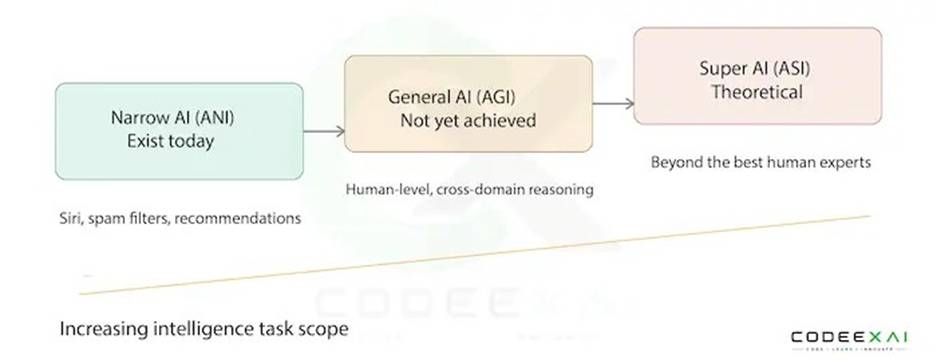
However, not all AI systems have the same capabilities. Based on their level of intelligence, AI is commonly classified into three main types.
What Are the Types of AI?
There are 3 main categories of Artificial Intelligence:
Artificial Narrow Intelligence (ANI)
Artificial General Intelligence (AGI)
Artificial Superintelligence (ASI)
These types are commonly classified according to their intelligence and ability to perform different tasks.
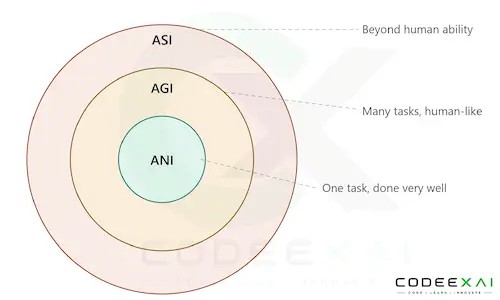
Narrow AI (ANI): Performs specific tasks within a limited area.
General AI (AGI): Would be able to learn, reason, and perform many intellectual tasks like a human.
Super AI (ASI): Would exceed human intelligence in nearly every area.
What Is Narrow AI or Weak AI?
Narrow AI, also called Weak AI or Artificial Narrow Intelligence (ANI), is an AI system designed to perform a specific task or a limited set of related tasks. It can be highly effective in its assigned area but does not possess general human-like understanding.
Examples of Narrow AI or Weak AI
Siri and Voice Assistants: Perform tasks such as answering questions, setting alarms, sending messages, and providing weather updates.
Spam Filters: Identify unwanted or potentially harmful emails by analyzing words, sender information, links, and message patterns.
Recommendation Engines: Suggest videos, products, music, or articles based on user behavior, searches, preferences, and viewing history.
Key Characteristics of Narrow AI
There are common characteristics include:
Performs specific or closely related tasks
Uses data, rules, machine learning, or neural networks
Can process large amounts of information quickly
Does not have human-like general intelligence
Cannot automatically perform every task a human can do
May perform very well in one area but fail outside that area
What Is General AI or AGI?
General AI, also called Artificial General Intelligence (AGI), is a theoretical form of AI that could understand, learn, reason, and apply knowledge across many different tasks at a human-like level.
What Would AGI Be Able to Do?
A true AGI could potentially:
Learn new skills from examples or instructions
Reason about unfamiliar situations
Solve problems across many subjects
Transfer knowledge between different tasks
Adapt when conditions change
Understand context more broadly
Plan and make decisions toward long-term goals
Example of General AI (AGI)
An AGI system might be able to:
Learn how to repair a device.
Apply that knowledge to solve a related problem.
Explain the solution clearly.
Adapt when new information becomes available.
Current Status of AGI
AGI has not been achieved or scientifically confirmed. Current AI systems can perform a wide range of tasks, including writing, coding, translation, image analysis, and question answering, but broad capability does not automatically mean general intelligence.
Example of a Hypothetical AGI
Imagine a system that can:
Learn a new language from study materials
Use the language in conversation
Teach it to another person
Apply the learning process to a different subject
Solve unfamiliar problems without being specifically trained for each one
Such broad and transferable intelligence would be closer to the idea of AGI than a system designed for only one task.
What Is Super AI or ASI?
Super AI, also called Artificial Superintelligence (ASI), is a theoretical AI that would surpass human intelligence in nearly every important intellectual area. It could potentially exceed the best human experts in reasoning, scientific discovery, creativity, planning, and problem-solving.
What Could Super AI Do?
A hypothetical ASI might be able to:
Solve highly complex scientific problems
Develop new technologies rapidly
Make discoveries beyond current human knowledge
Perform advanced reasoning more accurately than humans
Create new solutions across many fields
Improve its methods or capabilities under appropriate conditions
Narrow AI vs General AI vs Super AI
The following table compares the three main types of AI based on their capabilities and current status.
Feature | Narrow AI (ANI) | General AI (AGI) | Super AI (ASI) |
Intelligence level | Specialized | Human-like across many tasks | Beyond human intelligence |
Task capability | Limited or task-focused | Broad and adaptable | Extremely broad and advanced |
Learns new tasks | Usually within designed capabilities | Expected to learn across domains | Expected to learn and outperform humans |
Knowledge transfer | Limited | Strong cross-domain transfer | Potentially far beyond humans |
Current status | Exists today | Not achieved | Theoretical |
Example | Siri, spam filters, recommendation engines | Hypothetical human-level AI | Hypothetical superintelligent AI |
Simple Analogy
Think of the three categories as different levels of capability:
Narrow AI: A specialist who performs a particular job very well
General AI: A person who can learn and perform many different intellectual tasks
Super AI: A hypothetical intelligence that outperforms the best humans across nearly all fields
This analogy is simplified because human intelligence involves many abilities, including learning, reasoning, creativity, social understanding, and physical interaction.
Conclusion
The main types of AI are Narrow AI, General AI, and Super AI. Narrow AI is the only category that exists today and powers tools such as Siri, spam filters, and recommendation engines. AGI aims to achieve broad human-like intelligence, while ASI describes intelligence that would surpass humans, but both remain theoretical. The key takeaway is that modern AI can be highly capable without being generally intelligent.