
What Is a Heuristic?
A heuristic is an estimate of the cost from a given node to the goal. It is not exact — it only needs to guide the search toward the goal faster than exploring blindly.
h(n) = estimated cost from node n to the goal
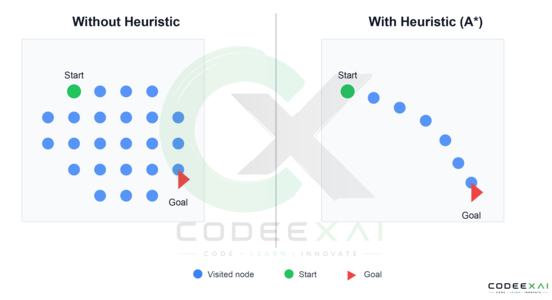
Figure 1: Heuristic search reaches the goal by visiting far fewer nodes than blind search.
Uninformed vs Informed Search
| Search Type | Uses Heuristic? | Examples |
|---|---|---|
| Uninformed | No | BFS, DFS, Dijkstra's Algorithm |
| Informed | Yes | A*, Greedy Best-First Search, IDA* |
What Is the A* Algorithm?
A* is a graph search algorithm that finds the lowest-cost path between a start node and a goal node. Published in 1968 by Hart, Nilsson, and Raphael, it combines the exact cost already spent reaching a node with an estimated cost to the goal, so it prioritizes nodes that are both cheap to reach and likely close to the goal.
Properties:
- Complete: finds a solution if one exists.
- Optimal: finds the shortest path if the heuristic is admissible.
- Efficient: expands fewer nodes than uninformed search when the heuristic is accurate.
The A* Formula: f(n) = g(n) + h(n)
| Term | Meaning |
|---|---|
| f(n) | Total estimated cost of the path through node n |
| g(n) | Exact cost from start to n |
| h(n) | Estimated cost from n to goal |
A* expands the node with the lowest f(n) at each step.
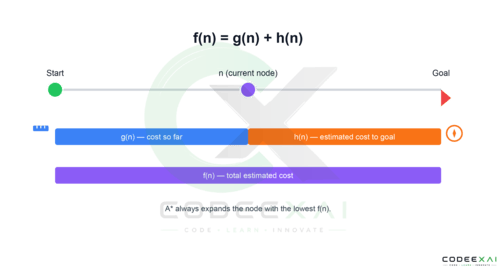
Figure 2: f(n) combines the known cost so far with the estimated remaining cost.
How A* Works
A* maintains an open list (discovered, unexplored nodes) and a closed list (fully explored nodes).
- Add start to open list; g(start) = 0, f(start) = h(start).
- While open list is not empty:
- Pick the node with lowest f(n) — call it current.
- If current is the goal, reconstruct and return the path.
- Move current to the closed list.
- For each neighbor not in the closed list:
- Compute tentative g = g(current) + cost(current, neighbor).
- If this is better than any known g for the neighbor, update g, h, f, and set current as its parent. Add the neighbor to the open list if not already present.
- If the open list empties without reaching the goal, no path exists.
Step-by-Step Example
A step-by-step example demonstrates how the A* algorithm explores nodes and chooses the shortest path to the goal. By calculating the g(n), h(n), and f(n) values at each step, you can clearly see why A* selects one node over another and how the optimal path is found.
Grid (4×4), each move costs 1, # = wall:
S  . .  .
.  # #  .
.  . #  .
.  # .  G
Heuristic: Manhattan distance, h(n) = |row - goal_row| + |col - goal_col|.
| Step | Node | g(n) | h(n) | f(n) |
|---|---|---|---|---|
| 1 | (0,0) S | 0 | 6 | 6 |
| 2 | (0,1) | 1 | 5 | 6 |
| 3 | (0,2) | 2 | 4 | 6 |
| 4 | (0,3) | 3 | 3 | 6 |
| 5 | (1,3) | 4 | 2 | 6 |
| 6 | (2,3) | 5 | 1 | 6 |
| 7 | (3,3) G | 6 | 0 | 6 |
Path: (0,0) → (0,1) → (0,2) → (0,3) → (1,3) → (2,3) → (3,3) — 6 steps, optimal.
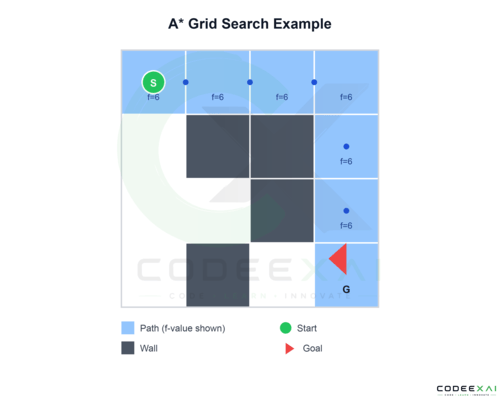
Figure 3: A visits only the cells needed to reach the goal.*
A* Algorithm Pseudocode
Pseudocode provides a language-independent representation of the A* algorithm. It focuses on the algorithm's logic rather than programming syntax, making it easier to understand before implementing it in any programming language.
function A_STAR(start, goal):
    open_list = priority queue containing start
    g_score[start] = 0
    f_score[start] = heuristic(start, goal)
    came_from = empty map

    while open_list is not empty:
        current = node in open_list with lowest f_score
        if current == goal:
            return reconstruct_path(came_from, current)

        remove current from open_list
        add current to closed_list

        for each neighbor of current:
            if neighbor in closed_list:
                continue
            tentative_g = g_score[current] + cost(current, neighbor)
            if neighbor not in open_list or tentative_g < g_score[neighbor]:
                came_from[neighbor] = current
                g_score[neighbor] = tentative_g
                f_score[neighbor] = tentative_g + heuristic(neighbor, goal)
                if neighbor not in open_list:
                    add neighbor to open_list

    return failure
Python Implementation
Now that you understand the working of the A* algorithm, let's implement it in Python. This implementation uses Python's built-in heapq module to efficiently manage the priority queue, ensuring that the node with the smallest f(n) value is always processed first.
import heapq
def heuristic(a, b):
    return abs(a[0] - b[0]) + abs(a[1] - b[1])  # Manhattan distance

def a_star(grid, start, goal):
    rows, cols = len(grid), len(grid[0])
    open_list = [(heuristic(start, goal), 0, start)]  # (f, g, node)
    came_from = {}
    g_score = {start: 0}
    visited = set()

    while open_list:
        f, g, current = heapq.heappop(open_list)

        if current == goal:
            path = [current]
            while current in came_from:
                current = came_from[current]
                path.append(current)
            return path[::-1]

        if current in visited:
            continue
        visited.add(current)

        row, col = current
        for neighbor in [(row+1, col), (row-1, col), (row, col+1), (row, col-1)]:
            nr, nc = neighbor
            if 0 <= nr < rows and 0 <= nc < cols and grid[nr][nc] != '#':
                tentative_g = g + 1
                if neighbor not in g_score or tentative_g < g_score[neighbor]:
                    g_score[neighbor] = tentative_g
                    f_score = tentative_g + heuristic(neighbor, goal)
                    heapq.heappush(open_list, (f_score, tentative_g, neighbor))
                    came_from[neighbor] = current

    return None

grid = [list("S..."), list(".##."), list("..#."), list(".#.G")]
path = a_star(grid, (0, 0), (3, 3))
print("Path found:", path)
Output:
Path found: [(0, 0), (0, 1), (0, 2), (0, 3), (1, 3), (2, 3), (3, 3)]- Explanation:
- heuristic() computes h(n) using Manhattan distance.
- open_list is a min-heap, so the lowest f(n) node is always processed first.
- g_score stores the cheapest known cost to each node.
- came_from stores parent pointers for path reconstruction.
- The loop expands the best node, checks for the goal, and updates neighbor scores when a cheaper path is found.
- Returns None if no path exists.
Admissible Heuristics
A heuristic h(n) is admissible if it never overestimates the true remaining cost:
h(n) ≤ actual cost from n to goal
An overestimating heuristic can cause A* to skip a shorter path, producing a suboptimal result.
| Heuristic | Formula | Use Case |
|---|---|---|
| Manhattan Distance | |x1-x2| + |y1-y2| | 4-directional grid movement |
| Euclidean Distance | sqrt((x1-x2)² + (y1-y2)²) | Free movement in any direction |
| Chebyshev Distance | max(|x1-x2|, |y1-y2|) | 8-directional grid movement |
| Zero Heuristic | h(n) = 0 | Reduces A* to Dijkstra's algorithm |
Consistency is a stricter property: for every node n and neighbor n', h(n) ≤ cost(n, n') + h(n'). Every consistent heuristic is admissible; consistency also guarantees a node's shortest path is found the first time it is expanded, so it never needs reopening.
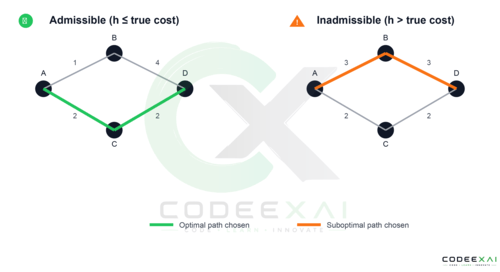
Figure 4: An inadmissible heuristic can cause A to miss the true shortest path.*
A* vs Dijkstra's Algorithm vs BFS
| Feature | BFS | Dijkstra's Algorithm | A* |
|---|---|---|---|
| Uses heuristic | No | No | Yes |
| Handles weighted edges | No | Yes | Yes |
| Guarantees shortest path | Yes (unweighted) | Yes | Yes (admissible h) |
| Search direction | Uniform | Uniform | Goal-directed |
| Nodes expanded | Moderate | High | Low (with good heuristic) |
Dijkstra's algorithm is equivalent to A* with h(n) = 0 for all nodes.
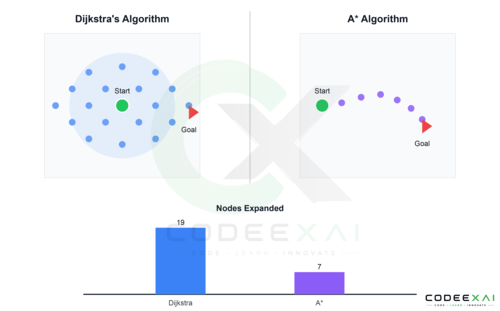
Figure 5: A expands fewer nodes than Dijkstra's algorithm because the heuristic directs the search toward the goal.*
Use Cases
- GPS navigation
- Video game NPC pathfinding
- Robot and drone motion planning
- Network packet routing
- Puzzle solving (8-puzzle, 15-puzzle)
- Delivery route optimization
Best Practices
- Use a heuristic close to the true cost without overestimating it.
- Prefer consistent heuristics to avoid reopening nodes.
- Implement the open list as a min-heap.
- Match the heuristic to the movement model (Chebyshev for 8-directional, Euclidean for free movement).
- Track visited nodes to prevent redundant work in graphs with cycles.
Common Mistakes
- Using an inadmissible heuristic, causing a suboptimal path.
- Not updating g(n) when a cheaper path to a node is found later.
- Scanning a plain list for the minimum f(n) instead of using a priority queue.
- Applying equal cost to diagonal and straight moves when diagonal movement should cost more (e.g., √2 vs 1).
- Failing to reverse the reconstructed path after backtracking from goal to start.
- Setting h(n) = 0 unintentionally, which reduces A* to Dijkstra's algorithm.
Summary
A* finds the shortest path using f(n) = g(n) + h(n), expanding the node with the lowest total estimated cost at each step. Optimality requires an admissible heuristic — one that never overestimates the true remaining cost. Compared to Dijkstra's algorithm and BFS, A* expands fewer nodes because the heuristic directs the search toward the goal.