Ai regulation means the laws and rules governments create to control how AI systems are built, sold, and used, so they stay safe and fair for people. As AI becomes more powerful, more countries are creating laws to manage its risks. In this guide, you will learn about the EU AI Act, its risk-based categories, and a quick snapshot of how other countries are handling AI regulation.
What is AI Regulation?
This part explains the basic meaning of AI regulation, in easy words.
Ai regulation is a set of laws and rules that control how companies build, sell, and use AI systems. These laws try to reduce real harms, like unfair decisions, privacy loss, or unsafe automated systems, while still allowing helpful AI to grow.
Governments create AI regulation for reasons like:
- Protecting people's basic rights and safety
- Stopping unfair or biased AI decisions
- Making AI companies more accountable for harm
- Building public trust in AI systems
Example: A country might pass a law saying that AI used for hiring decisions must be tested for bias before it can be used, so companies cannot use unfair, untested AI tools.
What is the EU AI Act?
This part explains the EU AI Act, the most detailed AI law in the world right now.
The EU AI Act is a law created by the European Union that controls how AI systems can be built and used across EU countries. It is widely seen as the first major, detailed ai regulation in the world, and it affects any company selling AI products to people in the EU, even if the company is based elsewhere.
Instead of treating all AI the same way, the EU AI Act sorts AI systems by how much danger they could cause, and applies stricter rules to riskier systems. This postponed the high-risk requirements: high-risk obligations from Annex III now apply starting 2 December 2027, and those from Annex I apply starting 2 August 2028. Dpo-consulting
Example: Under the EU AI Act, an AI chatbot used just for customer support has light rules, but an AI system used to decide loan approvals has much stricter rules, because it can seriously affect a person's life.
Risk-Based Categories in the EU AI Act
This part explains the four risk levels the EU AI Act uses to control different AI systems.
The EU AI Act's entire structure rests on one idea — risk categories. The EU AI Act sets out four risk levels for AI systems: unacceptable, high, limited, and minimal risk, with different rules and requirements for each class. Trail-mlDpo-consulting
- Unacceptable Risk: AI practices that are completely banned because they are too dangerous or harmful. This includes social scoring systems used by public authorities, AI systems that use subliminal techniques to manipulate behaviour, and specific AI systems for emotion recognition in workplace and educational settings. JAGGAER
- Example: A government system that scores citizens based on behavior and limits their rights would be banned.
- High Risk: AI systems allowed to be used, but only under strict rules, because they can seriously affect people's safety or rights. Systems are high-risk when used in sensitive domains — biometrics, critical infrastructure, education, employment and worker management, access to essential services, law enforcement, migration, and the administration of justice. Trail-ml
- Example: AI used to screen job candidates or approve loans falls into this category.
- Limited Risk: AI systems that mainly need to be transparent about being AI, not fully restricted. Chatbots must tell users they are talking to a machine, and AI-generated or manipulated media, including deepfakes, must be labelled. Trail-ml
- Example: A website chatbot must clearly tell users they are chatting with AI, not a human.
- Minimal Risk: AI systems with very low risk to people, so they face little to no special rules.
- Example: An AI spam filter or a simple recommendation system usually falls here.
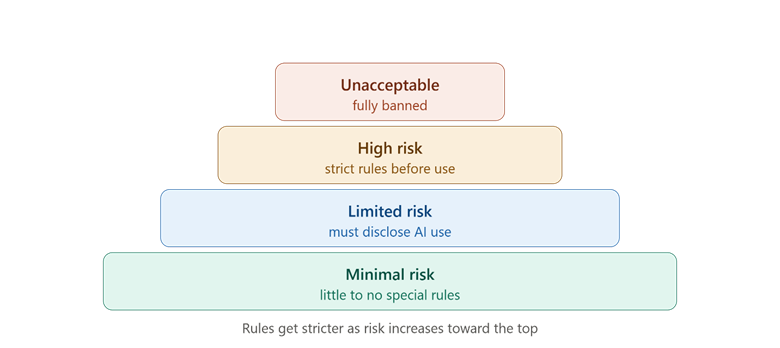
This picture shows the four risk levels of the EU AI Act, with stricter rules the higher the risk.
Code Example:
def classify_risk(use_case):
    banned = ["social scoring", "manipulative ai"]
    high_risk = ["hiring", "loan approval", "medical diagnosis"]
    limited_risk = ["chatbot", "deepfake generator"]

    if use_case in banned:
        return "Unacceptable risk - banned"
    elif use_case in high_risk:
        return "High risk - strict rules"
    elif use_case in limited_risk:
        return "Limited risk - must disclose AI use"
    else:
        return "Minimal risk - few rules"

print(classify_risk("hiring"))  # Output: High risk - strict rules
Explanation: This code shows a simple example of how a use case gets sorted into one of the four risk categories, similar to how the EU AI Act decides which rules apply to each AI system.
Comparison Table: EU AI Act Risk Categories
| Risk Level | Allowed? | Example Use Case |
| Unacceptable | No, fully banned | Government social scoring |
| High | Yes, with strict rules | Hiring AI, loan approval AI |
| Limited | Yes, must disclose AI use | Customer service chatbot |
| Minimal | Yes, few or no rules | Spam filter |
Global Regulatory Landscape Snapshot
This part gives a quick overview of how different regions outside the EU are approaching AI regulation.
Ai regulation looks different around the world. Some regions have detailed laws like the EU, while others rely more on guidelines or industry self-regulation.
- European Union: Has the most detailed, legally binding AI regulation through the EU AI Act, using the four-tier risk system described above.
- United States: Does not have one single federal AI law yet. It uses a mix of existing laws, state-level rules, and government guidance for different sectors.
- China: Has specific rules focused on areas like generative AI content, requiring companies to label AI-generated content and follow content restrictions.
- United Kingdom: Takes a lighter, sector-based approach, asking existing regulators, like finance or health regulators, to apply AI rules within their own industries instead of one single AI law.
- India: Currently relies more on general IT and data protection laws, with specific AI regulation still developing.
Example: A company selling the same AI product in the EU, US, and China may need to follow three very different sets of rules for the exact same product.
Conclusion
Ai regulation is growing quickly around the world, with the EU AI Act leading the way through its clear, risk-based system of unacceptable, high, limited, and minimal risk categories. Other regions, like the US, China, and the UK, are taking different paths, from strict laws to lighter, sector-based guidance. The key takeaway is that AI regulation is not one single global rulebook — companies building or using AI must understand the specific rules of each region they operate in.