

History of Artificial Intelligence
The history of Artificial Intelligence technology developed by the researchers and scientist over many decades. The question “Can machines imitate human intelligence?” put up by Alan Turning in 1950s.
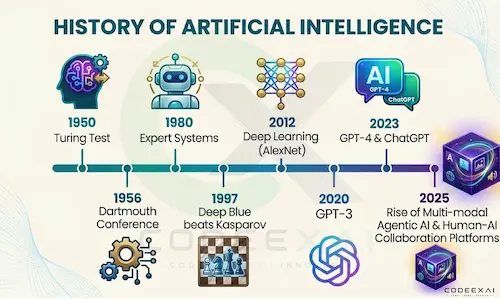
Later, researchers at the Dartmouth Conference in 1956 officially began developing AI as a field of study.
1. Early Foundations of AI (1940s–1950s)
The foundations of AI began with research in mathematics, logic, computer science, and neuroscience.
In 1943, Warren McCulloch and Walter Pitts proposed a mathematical model of an artificial neuron.
In 1950, British mathematician Alan Turing published his famous paper Computing Machinery and Intelligence. He introduced the question:
Can machines think?The Turing Test (1950)
One of the most important early milestones in the history of artificial intelligence was the work of British mathematician and computer scientist Alan Turing.
In 1950, Turing published his famous paper Computing Machinery and Intelligence. Instead of directly asking whether machines can think, he proposed a test known as the Turing Test.
2. The Birth of AI: Dartmouth Conference (1956)
The term Artificial Intelligence was officially introduced during the Dartmouth Summer Research Project on Artificial Intelligence in 1956.
The conference was organized by researchers including:
- John McCarthy
- Marvin Minsky
- Nathaniel Rochester
- Claude Shannon
This conference was organised to explore whether machines could be created to simulate human intelligence and think, learn, and solve problems like humans.
3. Early AI Programs (1950s–1960s)
During the 1950s and 1960s, researchers created some of the first AI programs. Some examples include:
Logic Theorist – one of the first AI programs, designed to prove mathematical theorems.
General Problem Solver (GPS) – developed to solve different types of problems.
ELIZA – an early chatbot that simulated a conversation with a human therapist.
SHRDLU – a system that could understand simple commands about objects in a virtual world.
During this period, many researchers were highly optimistic about the future of AI.
4. The First AI Winter (1970s)
Despite early progress, AI research faced major problems. Computers were not powerful enough to handle complex problems, and AI systems often worked only in limited situations. Many ambitious predictions about AI were not achieved.
As a result:
- Funding decreased.
- Research slowed down.
- Interest in AI declined.
- This period became known as the First AI Winter.
5. Expert Systems and AI Growth (1980s)
During the 1980s, Expert Systems became popular. Expert systems were AI programs designed to imitate the decision-making ability of human experts. They used:
- A knowledge base
- Rules
- An inference engine
For example, an expert system could help doctors identify possible diseases based on symptoms.
6. The Second AI Winter (Late 1980s–1990s)
As the limitations of expert systems became clear, interest and investment in AI again declined. This period is often called the Second AI Winter. At the same time, researchers continued developing important technologies such as:
- Machine learning
- Neural networks
- Statistical methods
- Computer vision
- Natural language processing
These technologies later became the foundation of modern AI.
7. Machine Learning Becomes Important (1990s–2000s)
AI began moving away from systems that relied only on manually programmed rules. Computers could learn patterns from data.
A major milestone occurred in 1997 when IBM's Deep Blue defeated world chess champion Garry Kasparov.
8. The Rise of Deep Learning (2010s)
The 2010s marked a major turning point in AI. The combination of:
- Large datasets
- Powerful GPUs
- Improved algorithms
- Neural networks
led to rapid progress in Deep Learning.
In 2012, a deep neural network called AlexNet achieved a major breakthrough in image recognition. This demonstrated the power of deep neural networks for processing visual information.
AI also made significant progress in:
- Speech recognition
- Image classification
- Natural language processing
- Autonomous vehicles
- Recommendation systems
9. AI Defeats Humans in Complex Games
AI achieved several important milestones in complex games. In 2016, AlphaGo, developed by DeepMind, defeated professional Go player Lee Sedol.
The achievement was significant because Go has an enormous number of possible moves and was considered extremely difficult for computers to master.
This demonstrated the power of combining:
- Deep learning
- Neural networks
- Reinforcement learning
10. The Rise of Generative AI (2020s)
In the 2020s, AI entered a new era known as Generative AI. Generative AI systems can create new content, including:
- Text
- Images
- Audio
- Video
- Computer code
Large Language Models (LLMs) have also become widely used for understanding and generating human language.
Today, AI is used in:
- Search engines
- Chatbots
- Healthcare
- Education
- Finance
- Software development
- Cybersecurity
- Robotics
- Content creation
- Autonomous systems
AI History Timeline
With the time AI improves the timeline of AI with changes is mentioned in the below table:
| Year | Milestone |
| 1943 | Artificial neuron model proposed |
| 1950 | Alan Turing proposed the Turing Test |
| 1956 | Dartmouth Conference officially established AI as a field |
| 1960s | Early AI programs and chatbots were developed |
| 1970s | First AI Winter |
| 1980s | Expert systems became popular |
| Late 1980s–1990s | Second AI Winter |
| 1997 | IBM Deep Blue defeated Garry Kasparov |
| 2012 | Deep learning achieved major success with AlexNet |
| 2016 | AlphaGo defeated Lee Sedol |
| 2020s | Generative AI and large language models became widely popular |