

Ai and data privacy is about how AI systems collect, use, and protect personal information, and the steps taken to stop that data from being misused or leaked. As AI systems use more and more personal data to work well, protecting that data becomes very important. In this guide, you will learn how AI models use data, the main privacy risks, how anonymization helps, and the basics of GDPR.
How Do AI Models Use Data?
This part explains how AI systems actually use personal data to work.
AI models need large amounts of data to learn patterns and make predictions. This data often includes personal details like names, locations, photos, or shopping habits. The AI studies this data during a process called training, and later uses new data to give real answers or predictions.
Example: A shopping app's AI studies your past purchases and browsing history to recommend products you might like. This is ai and data privacy in action — your personal shopping data is directly shaping what the AI shows you.
Code Example:
user_data = {"name": "Ravi", "purchases": ["shoes", "watch"]}

def recommend(user_data):
    if "shoes" in user_data["purchases"]:
        return "You might like: socks"
    return "No suggestion"

print(recommend(user_data))
Explanation: This code shows how an AI uses stored personal data — here, past purchases — to generate a suggestion. This simple pattern is how many real AI systems use personal data behind the scenes.
What Are the Privacy Risks of AI?
This part explains the main dangers that come from AI systems using personal data.
Using personal data in AI comes with real risks, especially when that data is collected, stored, or shared carelessly.
- Data leaks: Personal data stored for AI training can be stolen if security is weak.
- Re-identification: Even data that looks anonymous can sometimes be traced back to a real person by combining it with other data.
- Unwanted data use: Data collected for one purpose, like customer support, might get reused for AI training without the person's clear permission.
- Memorization: Some AI models can accidentally memorize and repeat private details from their training data.
Example: Researchers have shown that some AI language models can sometimes repeat exact private text they saw during training, like an email address, if asked the right way.
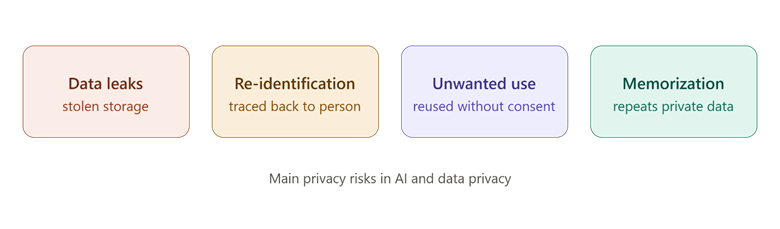
This picture shows the four main privacy risks that come with using personal data in AI.
What is Anonymization?
This part explains how personal data can be protected before it is used to train or run an AI system.
Anonymization means changing or removing personal details from data so that a specific person can no longer be identified from it. This lets companies still use the useful patterns in the data, without exposing exactly who the data belongs to.
Common anonymization techniques include:
- Masking: Hiding part of the data, like showing only the last 4 digits of a phone number.
- Generalization: Replacing exact details with broader categories, like changing "25 years old" to "20–30 years old."
- Pseudonymization: Replacing a name with a random ID code, so the real identity is hidden but the data can still be tracked internally.
- Data aggregation: Combining data from many people into one summary, so no single person's data stands out.
Code Example:
user = {"name": "Ravi Kumar", "phone": "9876543210", "age": 25}

def anonymize(user):
    return {
        "name": "User_" + str(hash(user["name"]) % 1000),
        "phone": "XXXXXX" + user["phone"][-4:],
        "age_group": "20-30"
    }

print(anonymize(user))
Explanation: This code replaces the real name with a random ID, hides most of the phone number, and turns the exact age into a range. This is a simple example of how anonymization protects identity while still keeping useful data.
What is GDPR?
This part explains the basics of GDPR, one of the most important privacy laws affecting AI systems.
GDPR , short for General Data Protection Regulation, is a privacy law from the European Union that controls how companies can collect, store, and use personal data, including data used to train AI systems. Even companies outside Europe must follow GDPR if they handle data from EU citizens.
Key GDPR rules that affect ai and data privacy include:
- Consent: Companies must clearly ask permission before collecting personal data.
- Right to access: People can ask what data a company has about them.
- Right to be forgotten: People can request their data be deleted.
- Data minimization: Companies should only collect data they actually need, not everything possible.
- Purpose limitation: Data collected for one reason cannot be freely reused for something else without permission.
Example: If a European user asks a company to delete their data, GDPR requires the company to remove that person's data, even if it was used to help train an AI model.
Comparison Table: GDPR Rights Related to AI and Data Privacy
| Right | What It Means | Impact on AI |
| Right to Consent | Must ask before collecting data | AI cannot use data without permission |
| Right to Access | User can see their stored data | Companies must track what data is used |
| Right to be Forgotten | User can request deletion | AI systems may need retraining without that data |
| Data Minimization | Collect only necessary data | Reduces the personal data AI models are exposed to |
Conclusion
Ai and data privacy is a growing concern because AI models rely heavily on personal data to learn and make predictions, which creates real risks like data leaks and unwanted reuse. Anonymization techniques and laws like GDPR help protect people by limiting how much personal data is exposed and giving users control over their own information. The key takeaway is that useful AI and strong privacy protection can work together, but only with careful data handling at every step.