

Explainable ai, also called XAI, means building AI systems that can show and explain the reason behind their decisions in a way humans can understand. Instead of just giving an answer, the AI also tells you why it gave that answer. In this guide, you will learn why black-box models are a problem, how tools like SHAP and LIME help explain AI decisions, and where explainability is actually needed.
What is Explainable AI?
This part explains the basic meaning of explainable AI, in easy words.
Explainable ai is a set of methods that help humans understand how and why an AI model made a certain decision. Normal AI models often just give an output, like "approved" or "rejected," without saying why. XAI tries to open up that decision and show the reasons behind it.
Example: If an AI rejects a loan application, explainable ai can show that the rejection happened mainly because of low income and short credit history, instead of just saying "rejected" with no reason.
Why Black-Box Models Are a Problem
This part explains why AI models that hide their reasoning can cause real problems.
A black-box model is an AI system where you can see the input and the output, but not how it reached that output inside. Many powerful AI models, like deep neural networks, are black boxes — they work well, but nobody can easily explain their exact reasoning.
This creates real problems:
- No trust: People may not trust a decision they cannot understand, especially in serious cases like medical diagnosis.
- Hidden bias: A black-box model can quietly use unfair patterns, and no one notices because the reasoning is hidden.
- No accountability: If an AI makes a harmful mistake, it's hard to fix the problem without knowing what caused it.
- Legal issues: In fields like banking, laws often require a clear reason for decisions like loan rejections.
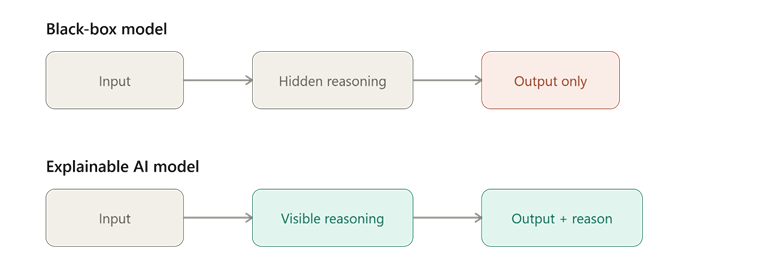
This picture shows the difference between a black-box model that hides its reasoning and an explainable ai model that shows it.
Code Example:
def loan_decision(income, credit_years):
    if income > 40000 and credit_years > 2:
        return "Approved"
    return "Rejected"

# Black-box style: only shows the result
print(loan_decision(35000, 1))  # Output: Rejected (no reason shown)
Explanation: This code gives a loan decision but does not explain why. This is exactly how a black-box model behaves — the person only sees "Rejected" with no idea which factor caused it.
Interpretability Techniques: SHAP and LIME Overview
This part explains two popular tools that help open up black-box models and show their reasoning.
Interpretability means how easily a human can understand an AI model's decision. Two of the most common tools used for this are SHAP and LIME.
- SHAP (SHapley Additive exPlanations): SHAP looks at how much each input feature pushed the final decision up or down, and gives each feature a fair "credit score" for its effect on the result.
- Example: SHAP might show that "low income" pushed a loan decision toward rejection by 60%, while "short credit history" pushed it by 40%.
- LIME (Local Interpretable Model-agnostic Explanations): LIME explains one single decision at a time. It makes small changes to the input and watches how the AI's answer changes, then builds a simple, easy explanation just for that one case.
- Example: LIME might explain a single rejected loan by showing that changing the income slightly would have flipped the decision to "Approved."
Both tools work with almost any AI model, which is why they are widely used in real explainable ai systems.
Code Example:
def explain_decision(income, credit_years):
    reasons = []
    if income <= 40000:
        reasons.append("Low income")
    if credit_years <= 2:
        reasons.append("Short credit history")
    decision = "Approved" if not reasons else "Rejected"
    return decision, reasons

result, reasons = explain_decision(35000, 1)
print("Decision:", result)
print("Reasons:", reasons)
Explanation: This code checks each input one by one and collects the exact reasons behind the final decision. This is a simplified version of what SHAP and LIME do in real systems — showing which factors caused the result.
Comparison Table: SHAP vs LIME
| Feature | SHAP | LIME |
| What it shows | Effect of every feature on the decision | Reason behind one single decision |
| Speed | Slower, more detailed | Faster, simpler |
| Best for | Deep, full analysis of a model | Quick explanation for one case |
| Based on | Game theory (fair credit sharing) | Testing small input changes |
Use Cases That Need Explainability
This part shows real areas where explainable ai is required, not just nice to have.
Some fields cannot use AI without a clear explanation, because a wrong or unfair decision can seriously harm someone. Common use cases include:
- Healthcare: A doctor needs to know why an AI flagged a scan as cancer, before trusting it for treatment.
- Banking and loans: Laws in many countries require banks to give a clear reason for rejecting a loan or credit card.
- Hiring: Companies need to show that a hiring AI is not unfairly rejecting candidates based on gender or race.
- Criminal justice: If AI helps decide bail or sentencing, courts need a clear reason, not just a hidden score.
Example: A hospital using AI to detect tumors in X-rays will only trust the tool if it can highlight exactly which part of the image led to its diagnosis.
Conclusion
Explainable ai solves a real problem — black-box models can be accurate but impossible to trust or check, especially in serious fields like healthcare and banking. Tools like SHAP and LIME help open up these models by showing which factors caused a decision, either across the whole model or for a single case. The key takeaway is that a good AI system should not just be right — it should also be able to explain why.