

Bias in ai happens when an AI system gives unfair results because of problems in its training data or design. Fairness in ai means making sure an AI system treats all groups of people equally, without favoring or harming any one group. In this guide, you will learn what bias means in AI, the different types of bias, what fairness means, and real examples of both.
What is Bias in AI?
This part explains the basic meaning of bias in AI, in easy words.
Bias in ai means an AI system makes unfair or wrong decisions for certain groups of people, usually because the data it learned from was not balanced or fair. AI learns patterns from data, so if the data has unfair patterns, the AI copies those unfair patterns too.
Example: If a hiring AI is trained mostly on resumes from male employees, it may unfairly reject female candidates, even if they are equally qualified, because it learned a biased pattern from the past data.
Types of Bias in AI
This part explains the different ways bias can enter an AI system.
Bias can come from many different places in an AI system, not just one. Here are the main types:
Data Bias: Happens when the training data does not fairly represent all groups.
Example: A face recognition system trained mostly on light-skinned faces performs poorly on darker-skinned faces.
Algorithmic Bias: Happens when the AI's own method of learning favors certain outcomes, even with balanced data.
Example: An algorithm that gives extra weight to zip codes may unfairly rank loan applicants from certain areas lower.
Human Bias: Happens when the people who build or label the training data bring their own unfair opinions into it.
Example: If people labeling photos link certain jobs only to one gender, the AI learns that same unfair link.
Measurement Bias: Happens when the data collected does not correctly measure what it claims to measure.
Example: Using arrest records to predict "crime risk" is unfair, because arrest rates can reflect biased policing, not actual crime.
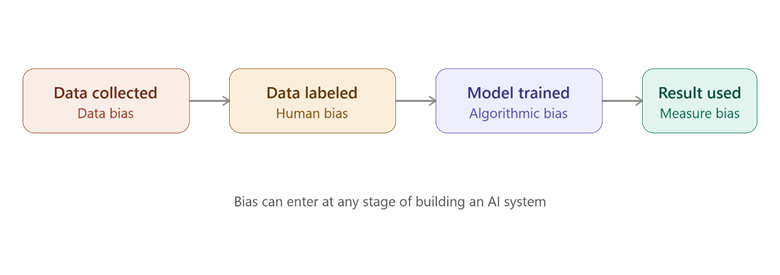
This picture shows how bias can slip into an AI system at four different stages, not just one.
Code Example:
resumes = [
    {"name": "Ravi", "gender": "M", "score": 85},
    {"name": "Anya", "gender": "F", "score": 90},
    {"name": "Kabir", "gender": "M", "score": 70},
]

# Biased rule: unfairly favors one gender
for r in resumes:
    if r["gender"] == "M":
        r["score"] += 10   # unfair boost

for r in resumes:
    print(r["name"], "-> Final score:", r["score"])
Explanation: This code shows an unfair rule that adds extra points only to male candidates, even if a female candidate scored higher before the boost. This is a simple, exaggerated way to show how bias in ai can silently change a fair result into an unfair one.
What is Fairness in AI?
This part explains what it means for an AI system to be fair.
Fairness in ai means an AI system gives equal treatment and equal chances to people from different groups, such as different genders, races, or ages, when making decisions. A fair AI system does not let a person's group membership unfairly change the result they get.
There are a few common ways to check fairness:
Equal Accuracy: The AI should be correct about the same percentage of the time for every group.
Equal Opportunity: Qualified people from every group should have an equal chance of getting a positive result, like a loan approval.
Demographic Parity: Different groups should receive positive outcomes at similar overall rates.
Example: A fair loan-approval AI should approve equally qualified applicants at a similar rate, whether they are men or women, or from any city.
Code Example:
def check_fairness(approved_A, total_A, approved_B, total_B):
    rate_A = approved_A / total_A
    rate_B = approved_B / total_B
    print("Group A approval rate:", rate_A)
    print("Group B approval rate:", rate_B)
    if abs(rate_A - rate_B) > 0.1:
        print("Warning: Possible unfairness detected")
    else:
        print("Approval rates look fair")

check_fairness(45, 50, 30, 50)
Explanation: This code compares the approval rate of two groups. If the gap between the two rates is too large, it prints a warning — this is a simple way developers check fairness in ai systems.
Comparison Table: Bias vs Fairness in AI
Term | Meaning in Simple Words | Goal |
Bias in AI | Unfair pattern learned by the AI | Something to find and remove |
Fairness in AI | Equal treatment across all groups | Something to build and check |
Data Bias | Unbalanced training data | Fix by collecting balanced data |
Algorithmic Bias | Unfair method inside the model | Fix by changing the model design |
How to Reduce Bias in AI
This part explains simple, practical ways teams try to make AI systems more fair.
Reducing bias in ai is not automatic — it needs active effort at every stage of building the system. Here are common ways teams do it:
Use balanced data — Collect training data that fairly represents all groups, not just one.
Test on different groups — Check the AI's accuracy separately for each group, not just overall.
Remove unfair features — Avoid using data like zip code or name that can secretly link to gender or race.
Add human review — Let a person double-check important AI decisions, like a loan rejection.
Recheck the model regularly — Bias can appear again over time as new data comes in, so testing must continue.
Example: Many companies now test hiring AI on resumes from different genders and backgrounds before using it, to catch unfair patterns early.
Conclusion
Bias in ai happens when unfair patterns from data, people, or algorithms quietly shape an AI's decisions, while fairness in ai is the goal of making sure every group gets equal, honest treatment. Checking for bias needs testing at every stage — from the data collected to the final decision made. The key takeaway is that fair AI does not happen by accident — it takes active checking and correction at every step.