

What Is Search in Artificial Intelligence?
Search in AI is the process of systematically exploring possible states of a problem to find a path from a starting state to a goal state. Many AI problems — from solving a maze to playing chess — can be modeled as a search tree or graph, where nodes represent states and edges represent actions that move between states.

BFS and DFS belong to a category called uninformed search algorithms (also called blind search), because they don't use any extra knowledge about how close a state is to the goal — they only use the structure of the graph itself. This is different from informed search algorithms like A*, which use a heuristic to guide the search.
What Is Breadth-First Search (BFS)?
Breadth-First Search (BFS) is a search algorithm that explores all nodes at the current depth level before moving to nodes at the next depth level. It uses a queue (first-in, first-out) data structure to keep track of which node to visit next.
How BFS Works
- Start at the root (initial) node and add it to a queue.
- Remove the front node from the queue and check if it's the goal.
- If not, add all of its unvisited neighbors to the back of the queue.
- Mark the node as visited.
- Repeat steps 2–4 until the goal is found or the queue is empty.
Because it processes nodes level by level, BFS is guaranteed to find the shortest path in a graph where all edges have equal weight (or no weight at all).
Real-World Example of BFS
A GPS navigation app modeling roads as an unweighted grid can use BFS to find the route with the fewest number of turns or hops between two points, since BFS explores all nearby locations before moving farther away. Social networks also use BFS-style logic to find the shortest degree of connection between two people (e.g., "second-degree connection" on LinkedIn).
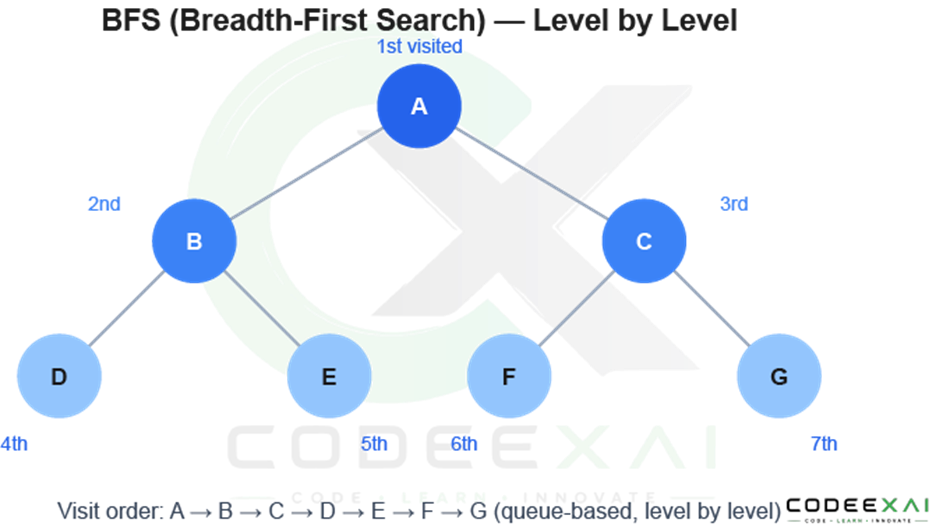
Figure 1: BFS visits nodes level by level using a queue — all nodes at the current depth are explored before moving deeper.
What Is Depth-First Search (DFS)?
Depth-First Search (DFS) is a search algorithm that explores as far as possible down one branch of the search tree before backtracking to try other branches. It uses a stack (last-in, first-out) data structure — either explicitly or through recursion.
How DFS Works:
- Start at the root node and mark it as visited.
- Pick an unvisited neighbor and move to it.
- Repeat step 2, going deeper along the branch.
- If a node has no unvisited neighbors, backtrack to the previous node.
- Continue until the goal is found or all nodes have been visited.
DFS does not guarantee the shortest path, but it uses far less memory than BFS in wide search spaces because it only needs to remember the current path, not every node at a given level.
Real-World Example of DFS
Solving a maze by always following one path until hitting a dead end, then backtracking, is a classic example of DFS in action. In AI, DFS is used in puzzle solvers (like Sudoku or the 8-puzzle) and in game-tree exploration, where an algorithm dives deep into one sequence of moves before evaluating alternatives.
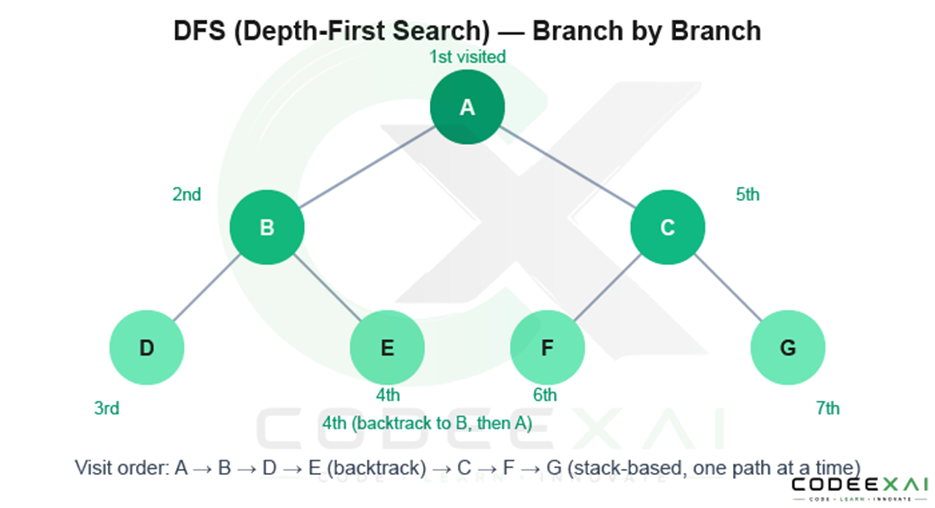
Figure 2: DFS dives down one branch as far as possible (A → B → D → E), backtracks, then explores the next branch (C → F → G).
BFS vs DFS: Key Differences
| Feature | BFS (Breadth-First Search) | DFS (Depth-First Search) |
| Data structure used | Queue (FIFO) | Stack (LIFO) or recursion |
| Exploration order | Level by level (wide) | Branch by branch (deep) |
| Shortest path guarantee | Yes, for unweighted graphs | No |
| Memory usage | Higher (stores all nodes at a level) | Lower (stores only current path) |
| Time complexity | O(V + E) | O(V + E) |
| Space complexity | O(V) | O(V) worst case, often less in practice |
| Best suited for | Finding shortest path, nearby solutions | Deep or narrow search spaces, memory-limited problems |
| Risk | High memory use on wide graphs | Can get stuck in infinite paths without a depth limit |
V = number of vertices (nodes), E = number of edges.
Time and Space Complexity of BFS and DFS
Both BFS and DFS have the same time complexity: O(V + E), where V is the number of nodes (vertices) and E is the number of edges, because both algorithms visit every node and edge once in the worst case.
Their space complexity differs in practice:
- BFS space complexity is O(V), since it can store an entire level of the graph in the queue at once — this becomes expensive for graphs that are wide (many nodes per level), such as a search tree with a high branching factor.
- DFS space complexity is also O(V) in the worst case (a single long path through every node), but in practice DFS often uses far less memory than BFS because it only tracks the current path plus backtracking points, not every explored node.
This memory trade-off is the main reason AI systems choose DFS over BFS when working with very large or deep search spaces, such as game trees.
Use Cases of BFS and DFS in AI
BFS and DFS are foundational to how AI systems explore problem spaces before adding more advanced heuristics.
BFS is used in AI for:
- Finding the shortest path in pathfinding and robotics navigation
- Web crawlers exploring links level by level from a starting page
- Finding the shortest sequence of moves in puzzle games
- Peer-to-peer network broadcasting and social network analysis
DFS is used in AI for:
- Game-tree search in board games like chess and tic-tac-toe (often paired with backtracking or minimax)
- Constraint satisfaction problems like Sudoku, N-Queens, and crossword generation
- Topological sorting for task scheduling and dependency resolution
- Detecting cycles in a graph, such as in planning or dependency graphs
Which Should You Use: BFS or DFS?
Choose BFS when you need the shortest path in an unweighted graph and memory isn't a major constraint, such as short pathfinding problems. Choose DFS when memory is limited, the search space is deep, or you need to explore every possible path (such as in constraint satisfaction or exhaustive puzzle solving) rather than the shortest one.
In practice, many real AI systems use variations or combinations of both — such as Iterative Deepening DFS, which combines DFS's low memory usage with BFS's ability to find the shortest path.
Conclusion
BFS and DFS in artificial intelligence are the two core uninformed search algorithms behind how AI systems explore problem spaces, from pathfinding to puzzle solving to game trees. BFS guarantees the shortest path in unweighted graphs but uses more memory, while DFS uses less memory and suits deep search spaces but doesn't guarantee the shortest solution. The right choice between BFS and DFS depends on whether your AI problem prioritizes finding the shortest path or conserving memory in a large, deep search space.